sumo-marouter — SUMO’s macroscopic assignment as an external-simulator adapter
What. sumo-marouter wraps eclipse-sumo’s macroscopic stochastic
user-equilibrium tool marouter (Lopez et al. 2018, [lopez2018microscopic],
docs/REFERENCES.md) as a benchmark model: it compiles a
fixed-demand, power==1 (linear-latency) scenario into a real SUMO network, runs
marouter to convergence under ITS OWN hardcoded cost law, reads the per-edge
flows back into repo-native units, and lets the harness certify the equilibrium
gap under the scenario’s DECLARED BPR costs (P1) — never marouter’s own.
Why it is in the benchmark. It is the first EXTERNAL simulator on the benchmark and the first row on the accuracy-vs-certificate ladder to ask a production tool to solve the repo’s own equilibrium: marouter’s cost law is a hardcoded linear-in-flow class function (PTV-Validate / VISUM-Cologne, not the ITSC paper), so the adapter’s job is a compile map — translating the scenario’s BPR coefficients into SUMO edge geometry (length, lane count) that reproduces the SAME cost law to machine precision on every REPRESENTABLE link. Three representability floors are unavoidable (a forced eps-intercept on zero-intercept links, a parasitic slope on zero-slope links, integer lane quantization) — refused loudly when they cannot be met, never silently clamped. See the model compendium and docs/design/adr-027-sumo-marouter.md (P1, the compile-map derivation and every measured anchor).
Scope. A certified Braess run (the measured mapping floor, A1), the
MANDATORY cost-matched anchor separating that floor from solver error (A2 — “the
row is not shipped without A2”), the asymmetric two-route direction where a
converged white-box solver certifies an orders-of-magnitude better gap (A3, the
feasibility-is-not-equilibrium-quality headline), and the honest negative
control (assignment_method="incremental", NOT an equilibrium) plus the traps
this adapter refuses rather than silently mis-scores.
How this notebook is graded
A notebook never claims a number it does not compute in that cell. Every
scored quantity below is recomputed live by the P1 Evaluator from the flows
marouter emitted, in the cell where it is claimed; the adapter’s own
--tolerance (SUE stability under ITS OWN costs) is never the certified gap.
marouter self-reports NO gap at all (provides_gap=False) — the certificate
is the only number, and it is the honest simulator-to-benchmark mapping floor,
never hidden (README, Certified, not self-reported).
# Setup. `sumo-marouter` is a GUARDED model behind the optional `eclipse-sumo`
# wheel (`pip install tabench[sumo]`) -- the ONLY guard cell in the tutorials so
# far. The inline backend is Agg-based (headless CI renders into the notebook);
# NEVER matplotlib.use("Agg") in-kernel -- it silently suppresses inline capture.
%matplotlib inline
try:
    import sumo  # noqa: F401  (the eclipse-sumo wheel; absence -> ModuleNotFoundError)
except ModuleNotFoundError as exc:
    if exc.name != "sumo":
        raise
    raise ModuleNotFoundError(
        "sumo-marouter needs the optional 'sumo' extra: pip install tabench[sumo]"
    ) from exc

import numpy as np

from tabench import (
    BiconjugateFrankWolfeModel,
    Budget,
    Evaluator,
    RngBundle,
    Trace,
    braess_scenario,
    two_route_scenario,
    viz,
)
from tabench.models.adapters import _sumo_io as sio
from tabench.models.adapters.sumo_marouter import SumoMarouterModel
The compile-map story (adr-027, Decision 3)
marouter does not take a user BPR function: its congestion law is hardcoded
per SUMO road class, linear in flow, t(f) = t0 (1 + K f/C). A repo link with
linear latency t(v) = A + B v (power == 1 only) compiles to a SUMO edge
whose length/lane-count reproduce (A, B) via t0 = A tau, slope = tau B/s
at a flow scale s chosen so every REPRESENTABLE link’s lane count is an exact
integer — matching the repo BPR to machine precision on those links. Zero-
intercept and zero-slope links force a small perturbation (an eps-intercept /
parasitic slope) that is the honest, MEASURED mapping floor below.
scenario = braess_scenario()  # demand=6.0, the A1 anchor
print(f"scenario      : {scenario.name}")
print(f"content hash  : {scenario.content_hash()[:16]}…")
print(f"total demand  : {scenario.demand.total}")
print("task          : marouter macroscopic SUE under its own hardcoded linear vdf")
scenario      : braess
content hash  : cf00f411cdccec88…
total demand  : 6.0
task          : marouter macroscopic SUE under its own hardcoded linear vdf
Solve
The model contract (CONTRIBUTING.md): a model receives
(scenario, budget, rng, trace). sumo-marouter maps iterations -> --max-iterations; marouter exposes no shortest-path count, so sp_calls
is unmappable and an sp_calls-only budget is REFUSED rather than run
unbounded. provides_gap=False, and the model discloses (never hides) that
marouter does not report its executed iteration count
(engine_iterations_executed_unknown=1, provenance).
model = SumoMarouterModel()  # defaults: assignment_method="SUE", route_choice="logit"
bundle = model.solve(scenario, Budget(iterations=50), RngBundle(42), Trace())

final = bundle.final
print(f"model            : {model.name}")
print(f"emitted flows    : {np.round(final.link_flows, 6)}")
print(f"engine           : {bundle.seed_info.get('engine', 'unknown')}  (provenance)")
print(f"engine_iterations_executed_unknown : "
      f"{final.self_report['engine_iterations_executed_unknown']:.0f}  (disclosed, not hidden)")
model            : sumo-marouter
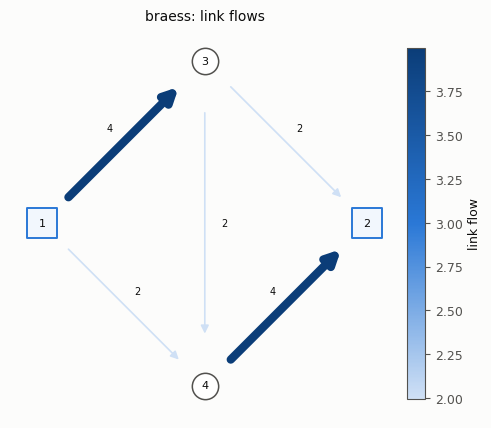
emitted flows    : [3.998156 2.001844 1.996313 2.001844 3.998156]
engine           : Eclipse SUMO marouter 1.27.1  (provenance)
engine_iterations_executed_unknown : 1  (disclosed, not hidden)
Certify (P1) — A1, the measured Braess mapping floor
The harness scores marouter’s Braess flows against the SAME certificate every
white-box solver here earns. The certified gap is real but small — the
measured mapping floor, not solver error (A2, next cell, is what proves that).
evaluator = Evaluator(scenario)
metrics = evaluator.evaluate(final.link_flows)
print(f"certified relative gap  : {metrics['relative_gap']:.3e}")
print(f"feasible                : {metrics['feasible']:.0f}")
print(f"node_balance_residual   : {metrics['node_balance_residual']:.2e}")
assert metrics["feasible"] == 1.0
assert metrics["relative_gap"] < 3e-4  # loose, version-robust ceiling (measured ~1.74e-4)
assert metrics["node_balance_residual"] < 1e-6

# Analytic Braess UE anchor, recomputed in-cell: marouter's flows sit within the
# measured perturbation floor of the true oracle (4,2,2,2,4), not exactly on it.
ref_flows = np.array([4.0, 2.0, 2.0, 2.0, 4.0])
assert evaluator.evaluate(ref_flows)["relative_gap"] < 1e-6
assert np.allclose(final.link_flows, ref_flows, atol=0.01)
print(f"analytic UE flows       : {ref_flows}  (marouter within the mapping-floor perturbation)")
certified relative gap  : 1.739e-04
feasible                : 1
node_balance_residual   : 4.44e-16
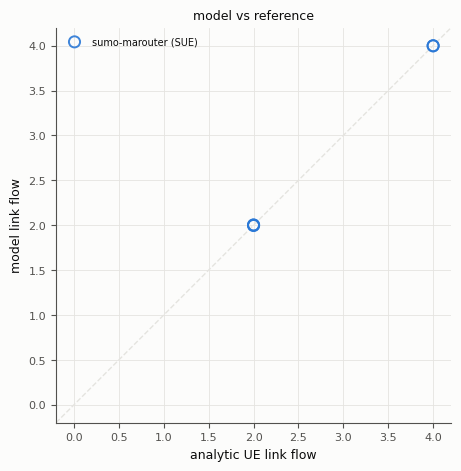
analytic UE flows       : [4. 2. 2. 2. 4.]  (marouter within the mapping-floor perturbation)
A2 — the MANDATORY cost-matched anchor
The certified gap above is only INTERPRETABLE if marouter’s own internal costs
match the repo’s declared BPR at the emitted flows on every representable link —
otherwise the “small gap” could just as well be a cost-model mismatch. This
notebook runs the SAME compile step + marouter invocation the adapter uses
internally (via the public _sumo_io converter), reads marouter’s own
traveltime attribute, and diffs it against scenario.network.link_cost at the
emitted flows. “The row is not shipped without A2” (adr-027).
import os
import shutil
import subprocess
import tempfile


def _run_marouter_direct(scenario, theta, paths, method="SUE"):
    # The adapter's own compile+run steps, exposed here to read marouter's
    # INTERNAL traveltime attribute (not just the flows) -- the A2 cost-match check.
    workdir = tempfile.mkdtemp(prefix="tabench-sumo-a2-")
    try:
        build = sio.scenario_to_sumo(scenario, workdir, time_scale=1.0, min_lanes=1)
        netload = os.path.join(workdir, "nl.xml")
        cmd = [
            sio.sumo_binary("marouter"),
            "--net-file", build.net_file, "--additional-files", build.taz_file,
            "--od-matrix-files", build.od_file, "--netload-output", netload,
            "--output-file", os.devnull, "--precision", "9",
            "--weights.minor-penalty", "0", "--left-turn-penalty", "0",
            "--capacities.default", "true", "--assignment-method", method,
            "--route-choice-method", "logit", "--logit.beta", "0", "--logit.gamma", "0",
            "--logit.theta", repr(float(theta)), "--paths", str(paths),
            "--max-iterations", "50", "--max-inner-iterations", "5000",
            "--tolerance", "1e-7", "--seed", "42", "--routing-threads", "1",
        ]
        proc = subprocess.run(cmd, env=sio.sumo_env(), capture_output=True, text=True, cwd=workdir)
        assert proc.returncode == 0, proc.stderr[-1000:]
        n = scenario.network.n_links
        flows = sio.parse_netload(netload, n, build.flow_scale)
        tt = sio.parse_netload_attr(netload, n, "traveltime")
        return flows, tt, build
    finally:
        shutil.rmtree(workdir, ignore_errors=True)


for sc, label in ((braess_scenario(), "braess"), (two_route_scenario(sue_theta=None), "two-route")):
    # theta=200.0, paths=4: SumoMarouterModel()'s own defaults (logit_theta / time_scale
    # at time_scale=1.0, and the "paths" factor) -- this must be the SAME run the model
    # made above, or the cost-match check would not anchor A1/A3 at all.
    flows_a2, tt, build = _run_marouter_direct(sc, 200.0, 4)
    rep = build.representable
    repo_cost = sc.network.link_cost(flows_a2)
    diff = np.abs(tt[rep] / build.time_scale - repo_cost[rep])
    print(f"{label:10s}: {rep.sum()}/{len(rep)} representable links, "
          f"max |marouter cost - repo BPR cost| = {diff.max():.2e}")
    assert rep.any()
    assert diff.max() < 1e-6
braess    : 3/5 representable links, max |marouter cost - repo BPR cost| = 3.57e-10
two-route : 2/4 representable links, max |marouter cost - repo BPR cost| = 1.56e-10
A3 — asymmetric two-route: feasibility is not equilibrium quality
On the ASYMMETRIC two-route corridor (deterministic UE f_A = 2.5 at D=4;
theta is calibrated on THIS anchor, never symmetric Braess, whose UE is the
equal split at any theta), marouter certifies a small but real gap while a
converged white-box bfw certifies an orders-of-magnitude better one — the
honest headline of this whole external-engine ladder: an industrially converged
simulator run is not the same claim as a certified equilibrium.
sc_tr = two_route_scenario(sue_theta=None)
bundle_tr = SumoMarouterModel().solve(sc_tr, Budget(iterations=50), RngBundle(42), Trace())
metrics_tr = Evaluator(sc_tr).evaluate(bundle_tr.final.link_flows)
print(f"marouter  : relative_gap = {metrics_tr['relative_gap']:.3e}")
assert metrics_tr["feasible"] == 1.0
assert metrics_tr["relative_gap"] < 1e-3

bfw_trace = Trace()
BiconjugateFrankWolfeModel().solve(
    sc_tr, Budget(iterations=200, target_relative_gap=1e-10), RngBundle(0), bfw_trace
)
bfw_gap = Evaluator(sc_tr).evaluate(bfw_trace.final.link_flows)["relative_gap"]
print(f"bfw       : relative_gap = {bfw_gap:.3e}  (an orders-of-magnitude better certificate)")
assert bfw_gap < metrics_tr["relative_gap"] / 10.0
marouter  : relative_gap = 5.445e-04
bfw       : relative_gap = 0.000e+00  (an orders-of-magnitude better certificate)
The honest negative control, and the traps this adapter refuses
marouter’s DEFAULT assignment_method="incremental" is NOT an equilibrium —
certified here as a much worse gap, feasible but honestly far from UE. Three
more traps are refused loudly rather than silently mis-scored:
assignment_method="UE" (marouter silently falls back to SUE — declaring it
would poison the manifest), non-logit route choice (gawron/lohse emit
all-zero flows in this macroscopic setting), and an SUE-scenario (marouter’s
adapter targets the deterministic instance only).
bundle_inc = SumoMarouterModel(assignment_method="incremental").solve(
    scenario, Budget(iterations=50), RngBundle(42), Trace()
)
metrics_inc = Evaluator(scenario).evaluate(bundle_inc.final.link_flows)
print(f"incremental (default, NOT an equilibrium) : "
      f"relative_gap = {metrics_inc['relative_gap']:.3e}  feasible = {metrics_inc['feasible']:.0f}")
assert metrics_inc["feasible"] == 1.0
assert metrics_inc["relative_gap"] > 0.05  # honestly much worse than SUE's mapping floor

try:
    SumoMarouterModel(assignment_method="UE").solve(scenario, Budget(iterations=5), RngBundle(0), Trace())
    raise AssertionError("expected assignment_method='UE' to be refused")
except ValueError as exc:
    print(f"assignment_method='UE' refused : {exc}"[:100] + "…")

try:
    SumoMarouterModel(route_choice="gawron").solve(scenario, Budget(iterations=5), RngBundle(0), Trace())
    raise AssertionError("expected route_choice='gawron' to be refused")
except ValueError as exc:
    print(f"route_choice='gawron' refused  : {exc}"[:100] + "…")

try:
    SumoMarouterModel().solve(two_route_scenario(), Budget(iterations=5), RngBundle(0), Trace())
    raise AssertionError("expected an SUE-theta scenario to be refused")
except ValueError as exc:
    print(f"SUE-theta scenario refused     : {exc}"[:100] + "…")
incremental (default, NOT an equilibrium) : relative_gap = 7.128e-02  feasible = 1
assignment_method='UE' refused : assignment_method='UE' is refused: marouter does not implement dete…
route_choice='gawron' refused  : route_choice is restricted to 'logit' (gawron/lohse emit all-zero f…
SUE-theta scenario refused     : sumo-marouter accepts only fixed-demand power==1 UE scenarios; scen…
Visualize
sumo-marouter’s certified artifact is per-LINK flows on a road Network —
the same artifact shape every static/day-to-day model here emits — so
tabench.viz applies directly (adr-035’s viz rule).
display(viz.plot_network_flows(scenario.network, final.link_flows))
display(viz.plot_flow_scatter(("analytic UE", ref_flows), {"sumo-marouter (SUE)": final.link_flows}))
Takeaways & pointers
Certified, not self-reported.
marouterreports no gap at all (provides_gap=False); every number above came from the harness’s ownEvaluator, recomputed from the emitted flows.A2 is the load-bearing anchor. Without proving marouter’s own costs match the declared BPR on representable links, “the gap is small” would not mean “the mapping is faithful” — it could just as well be a cost-model mismatch.
Feasible is not equilibrium. A3 makes the headline literal:
marouter’s industrially converged SUE andbfw’s certified equilibrium are DIFFERENT claims, scored on the same axis, andbfwwins the convergence axis as expected.Where next. the compile-map derivation and every representability floor in docs/design/adr-027-sumo-marouter.md; the white-box UE ladder this compares against
bfw; the lineage in the model compendium.