gls — Generalized Least Squares OD estimation (covers prior)
What. gls (T2, ADR-002) recovers an OD demand matrix from a set of
observed link counts by minimizing a weighted sum of the prior misfit and the
count misfit: min_g (g-g_pr)'W^-1(g-g_pr) + (p g - c)'V^-1(p g - c), where
p is the (MSA-averaged) route-choice proportion matrix. It is the classical
anchor every other T2 estimator in this benchmark is compared against. This
notebook also covers prior — the stale-prior baseline gls is scored
against is not a strawman but a first-class registered estimator
(PriorBaseline, which emits the prior unchanged).
Why it is in the benchmark. OD estimation from traffic counts is
underdetermined (Willumsen 1981, Cascetta 1984): gls is the field’s
best-known regularized solution, and it needs its own MSA-proportion
observation model (LinkCounts) and its own T2 held-out certification
contract, both new relative to T1/day-to-day. See the
model compendium (Cascetta 1984) and
docs/design/adr-002-t2-estimation-certificate.md
(P1).
Scope. This notebook certifies the scalar closed form, then the public
run_estimation_experiment API end-to-end on Braess, comparing gls against
the prior baseline it must beat, and finally the harder global-basin
Braess D=6 recovery.
Canon. [cascetta1984estimation], docs/REFERENCES.md / docs/references.bib.
How this notebook is graded
A notebook never claims a number it does not compute in that cell. Every
scored quantity below is recomputed live by the P1 ODCertifier from the
emitted OD matrix against the harness’s OWN pinned BFW assignment of the
truth — never from the estimator’s self-report
(README, Certified, not self-reported).
# Setup. `gls` is a core estimator: a plain `pip install -e .` suffices — no
# optional extra, so no guard cell. The inline backend is Agg-based (headless
# CI renders into the notebook); NEVER matplotlib.use("Agg") in-kernel — it
# silently suppresses inline figure capture.
%matplotlib inline
import numpy as np

from tabench import (
    Budget,
    GLSEstimator,
    ODCertifier,
    PriorBaseline,
    RngBundle,
    braess_scenario,
    run_estimation_experiment,
    two_route_scenario,
    viz,
)
from tabench.estimation import ODTrace, gls_solve
from tabench.estimation.base import EstimationTask
from tabench.core.rng import SOURCE_OBSERVATION
from tabench.observe.levels import LinkCounts
from tabench import Demand
from tabench.models.frank_wolfe import BiconjugateFrankWolfeModel
from tabench import Trace
The closed form: a scalar anchor
Single pair, single sensor, W=V=1: the GLS solve reduces to
g* = (g_pr + p*c) / (1 + p^2) — a weighted average of the prior and the
count-implied demand c/p. Recomputed here from gls_solve directly, no
trusted digits.
p, c, g_pr = 0.625, 2.5, 3.0
expected = (g_pr + p * c) / (1.0 + p * p)
got = gls_solve(
    np.array([[p]]), np.array([c]), np.array([g_pr]), np.array([1.0]), np.array([1.0])
)
print(f"gls_solve      : {got[0]:.6f}")
print(f"closed form    : {expected:.6f}")
assert np.isclose(got[0], expected, atol=1e-10)
gls_solve      : 3.280899
closed form    : 3.280899
An end-to-end run: Braess, four sensors + one held out, gls vs prior
braess_scenario(6.0) is the D=6 Braess network (link order 1->3, 1->4, 3->4, 3->2, 4->2), frozen and content-hashed (P2). We run BOTH registered
estimators through the public run_estimation_experiment API with a
noiseless, exact-prior card: four links are observed and the middle link
3->4 is reserved as the held-out set — heldout_count_rmse is THE ranking
column, so the design must reserve one (an empty held-out set is rejected on
both T2 tracks, ADR-002/ADR-023). The prior baseline just echoes its
(exact) input, so gls must do at least as well, and — under a noiseless
card where the prior IS the truth — essentially exactly.
sc = braess_scenario(6.0)
print(f"scenario      : {sc.name}")
print(f"content hash  : {sc.content_hash()[:16]}…")

cfg = {
    "sensors": {"kind": "explicit", "links": [0, 1, 3, 4]},
    "heldout": {"kind": "explicit", "links": [2]},
    "n_periods": 1,
    "noise": "none",
    "prior": {"kind": "stale", "cv": 0.0},
    "identifiability_k_inner": 30,
}
result = run_estimation_experiment(
    sc, [PriorBaseline(), GLSEstimator(k_inner=40, outer_iters=8)],
    Budget(sp_calls=2000), seed=0, macroreps=1, estimation=cfg,
)
required = {
    "task_hash", "od_feasible", "obs_count_rmse", "oracle_obs_count_rmse",
    "heldout_count_rmse", "od_rmse", "od_nrmse", "total_demand_error",
    "od_identifiable",
}
assert required <= set(result.rows[0])
assert result.manifest["identifiability"]["linear_identifiable"] is True

prior_row = [r for r in result.rows if r["estimator"] == "prior"][-1]
gls_row = [r for r in result.rows if r["estimator"] == "gls"][-1]
print(f"prior  : od_feasible={prior_row['od_feasible']:.0f}  od_rmse={prior_row['od_rmse']:.4f}")
print(f"gls    : od_feasible={gls_row['od_feasible']:.0f}  od_rmse={gls_row['od_rmse']:.4f}")
assert prior_row["od_feasible"] == 1.0 and gls_row["od_feasible"] == 1.0
# cv=0 prior IS the truth: prior is exact, gls (an iterative fixed point
# around the same truth) stays within a small inner-assignment slack.
assert prior_row["od_rmse"] < 1e-9
assert gls_row["od_rmse"] < 1e-2
scenario      : braess
content hash  : cf00f411cdccec88…
prior  : od_feasible=1  od_rmse=0.0000
gls    : od_feasible=1  od_rmse=0.0007
The harder anchor: global-basin recovery from an off prior
From an off prior D=5.5 (inside gls’s global basin — see
spiess for the D=4 SPURIOUS-basin caveat this network
also has), full noiseless sensors let gls recover Braess’s true D=6
demand to a tight tolerance. Built by hand here (EstimationTask +
LinkCounts, the same primitives run_estimation_experiment uses
internally) so the certificate is scored against an explicit oracle.
BRAESS_TRUTH = np.array([4.0, 2.0, 2.0, 2.0, 4.0])  # UE(D=6), recomputed below

trace_pin = Trace()
BiconjugateFrankWolfeModel().solve(
    sc, Budget(iterations=5000, target_relative_gap=1e-10), RngBundle(0), trace_pin
)
oracle_flows = trace_pin.final.link_flows
np.testing.assert_allclose(oracle_flows, BRAESS_TRUTH, atol=1e-6)

prior_matrix = np.zeros((2, 2))
prior_matrix[0, 1] = 5.5
ds = LinkCounts(np.arange(5), 1, "none").observe(
    sc, oracle_flows, RngBundle(0).generator(SOURCE_OBSERVATION)
)
task = EstimationTask(
    name="t", network=sc.network, prior=Demand(prior_matrix), dataset=ds,
    identifiability={}, scenario_hash=sc.content_hash(), seed=0,
)
trace = ODTrace()
GLSEstimator(k_inner=120, outer_iters=80, cv_prior=50.0).estimate(
    task, Budget(sp_calls=10**9, iterations=200), RngBundle(0), trace
)
recovered = trace.final.od_matrix[0, 1]
print(f"recovered D    : {recovered:.4f}  (truth: 6.0, off prior: 5.5)")
assert abs(recovered - 6.0) < 1e-3

certifier = ODCertifier(
    sc, np.arange(5), np.array([], dtype=np.int64),
    oracle_flows[None, :], oracle_flows[[]][None, :], oracle_flows,
    {"linear_identifiable": True},
)
metrics = certifier.certify(trace.final.od_matrix)
print(f"certified od_rmse : {metrics['od_rmse']:.4e}")
assert metrics["od_feasible"] == 1.0
assert metrics["od_rmse"] < 1e-3
recovered D    : 6.0000  (truth: 6.0, off prior: 5.5)
certified od_rmse : 1.2068e-05
Visualize
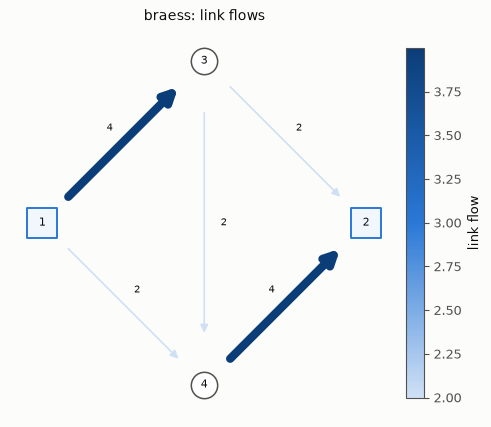
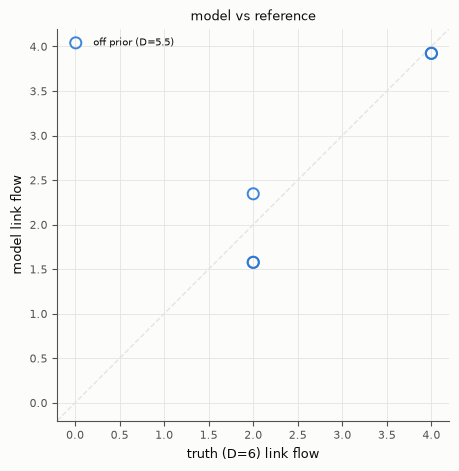
tabench.viz draws the road Network’s link flows: the certified gls
recovery vs the off prior, both re-derived from the OD matrices above by
re-running the pinned assignment (the same one the certifier scores against).
prior_flows = trace_pin.final.link_flows  # truth flows for reference
prior_trace = Trace()
from tabench import Scenario
BiconjugateFrankWolfeModel().solve(
    Scenario("prior", sc.network, Demand(prior_matrix), family=sc.family),
    Budget(iterations=5000, target_relative_gap=1e-10), RngBundle(0), prior_trace,
)
display(viz.plot_network_flows(sc.network, trace_pin.final.link_flows))
display(viz.plot_flow_scatter(
    ("truth (D=6)", trace_pin.final.link_flows),
    {"off prior (D=5.5)": prior_trace.final.link_flows},
))
Takeaways & pointers
Certified, not self-reported. Every
od_rmse/od_feasibleabove came fromODCertifier’s own re-assignment of the emitted OD matrix, never fromgls’s internal proportions.prioris a first-class competitor, not a strawman. It is the baseline every T2 estimator on this benchmark must beat; this notebook certifies it directly (ADR-002covers: [prior]).Where next. the entropy-balancing alternative
vzw-entropy; the spurious-local-minimum caveat on this SAME network inspiess; the spatial-covariance cousinod-kalman; the lineage in the model compendium.