dtd-swap — Smith’s (1984) route-swap day-to-day dynamics
What. Each day, travellers swap from costlier to cheaper routes at a rate proportional to the cost difference and the costlier route’s flow (Smith’s pairwise swap). Its fixed point is the Wardrop UE.
Why it is in the benchmark. It carries the day-to-day signature the static solvers lack: Beckmann is a Lyapunov function descending monotonically to the UE value (Ż = −a·V ≤ 0), and Smith’s flow-weighted disequilibrium vanishes exactly at Wardrop equilibrium. See the model compendium and the certificate design in docs/ARCHITECTURE.md (P1).
Scope. Runs the process on a built-in scenario and certifies the result; it does not benchmark day-to-day models against each other. Reference: Smith, M.J. (1984), Transportation Science 18(3).
Canon. [smith1984stability], docs/REFERENCES.md / docs/references.bib.
How this notebook is graded
A notebook never claims a number it does not compute in that cell. Every scored
quantity below is recomputed live by the P1 Evaluator from the flows the model
emitted, in the cell where it is claimed. Model self-reports (the per-day gap/residual,
the Lyapunov value) are shown only as provenance and diffed against the certificate,
exactly as the harness treats them (README, Certified, not
self-reported).
# Setup. `dtd-swap` is a core day-to-day model: a plain `pip install -e .` suffices —
# no optional extra, so no guard cell. The inline backend is Agg-based (headless CI
# renders into the notebook); NEVER matplotlib.use("Agg") in-kernel — it silently
# suppresses inline figure capture.
%matplotlib inline
import numpy as np

from tabench import (
    Budget,
    Evaluator,
    RngBundle,
    RouteSwapDTDModel,
    Trace,
    braess_scenario,
    viz,
)
The scenario
The built-in Braess network (4 nodes, 5 links, one OD pair 1→2, demand 6). Scenarios are frozen and content-hashed (P2) — the hash below is the benchmark instance’s identity.
scenario = braess_scenario()
net = scenario.network
print(f"scenario      : {scenario.name}")
print(f"content hash  : {scenario.content_hash()[:16]}…")
print(f"links         : {net.n_links}  (tail→head: "
      + ", ".join(f"{i}->{j}" for i, j in zip(net.init_node, net.term_node)) + ")")
print(f"total demand  : {scenario.demand.total}")
print("task          : Wardrop UE fixed point")
scenario      : braess
content hash  : cf00f411cdccec88…
links         : 5  (tail→head: 1->3, 1->4, 3->4, 3->2, 4->2)
total demand  : 6.0
task          : Wardrop UE fixed point
Run the adjustment process
The model contract (CONTRIBUTING.md): a model receives
(scenario, budget, rng, trace) and records one checkpoint per day — here a budget
iteration is a day. Everything the model writes into self_report (the per-day
gap/residual, the Lyapunov value) is provenance, not a score.
bundle_trace = Trace()
model = RouteSwapDTDModel()
model.solve(scenario, Budget(iterations=800, target_relative_gap=1e-8),
            RngBundle(0), bundle_trace)
final = bundle_trace.final
print(f"model            : {model.name}")
print(f"days simulated   : {final.coords.iterations}  "
      f"({final.coords.sp_calls} shortest-path calls)")
print(f"emitted flows    : {np.round(final.link_flows, 6)}")
print(f"self-reported gap     : {final.self_report['relative_gap']:.3e}  (provenance only)")
model            : dtd-swap
days simulated   : 316  (317 shortest-path calls)
emitted flows    : [4. 2. 2. 2. 4.]
self-reported gap     : 9.989e-09  (provenance only)
Certify (P1) — the fixed point AND the descent
The harness, never the model, computes every scored metric. Certified here: (1) the terminal flows are the Wardrop UE — relative gap → 0 with the analytic Braess anchor recomputed in-cell; (2) the day-to-day signature — Beckmann descends monotonically to 386 — plus this model’s distinctive provenance measure.
evaluator = Evaluator(scenario)
metrics = evaluator.evaluate(final.link_flows)
gap = metrics["relative_gap"]
print(f"certified relative gap : {gap:.3e}")
print(f"feasible               : {metrics['feasible']:.0f}")
assert metrics["feasible"] == 1.0
assert gap < 1e-6
# Analytic Braess UE anchor, recomputed in-cell (flows (4,2,2,2,4), every route costs 92).
ref_flows = np.array([4.0, 2.0, 2.0, 2.0, 4.0])
assert evaluator.evaluate(ref_flows)["relative_gap"] < 1e-6
assert np.allclose(final.link_flows, ref_flows, atol=1e-4)
route_time = metrics["tstt"] / scenario.demand.total
print(f"route time (TSTT/D)    : {route_time:.4f}  (analytic UE: 92)")
assert abs(route_time - 92.0) < 1e-2
# Beckmann is a Lyapunov function: monotone non-increasing to the UE value 386.
beckmann = [s.self_report["beckmann"] for s in bundle_trace]
assert all(beckmann[i] >= beckmann[i + 1] - 1e-9 for i in range(len(beckmann) - 1))
assert abs(beckmann[-1] - 386.0) < 1e-2
print(f"Beckmann descent       : {beckmann[0]:.2f} → {beckmann[-1]:.2f}  (monotone ✓)")
# Honesty diff (P1): the terminal self-reported Beckmann value against the SAME
# quantity the certificate itself computes from final.link_flows -- the Lyapunov
# claim is not backed by self-report alone.
assert np.isclose(beckmann[-1], metrics["beckmann_objective"], atol=1e-6)
# Smith's flow-weighted disequilibrium V(h)=Σ h_p([c_p−c_k]+)² is >0 off-equilibrium
# and vanishes exactly at Wardrop UE (provenance).
diseq = [s.self_report["smith_disequilibrium"] for s in bundle_trace]
assert max(diseq) > 1.0 and diseq[-1] < 1e-6
print(f"Smith disequilibrium   : {max(diseq):.3g} → {diseq[-1]:.2e}  (→ 0 at UE)")
certified relative gap : 9.989e-09
feasible               : 1
route time (TSTT/D)    : 92.0000  (analytic UE: 92)
Beckmann descent       : 438.00 → 386.00  (monotone ✓)
Smith disequilibrium   : 5.17e+03 → 3.04e-11  (→ 0 at UE)
Visualize
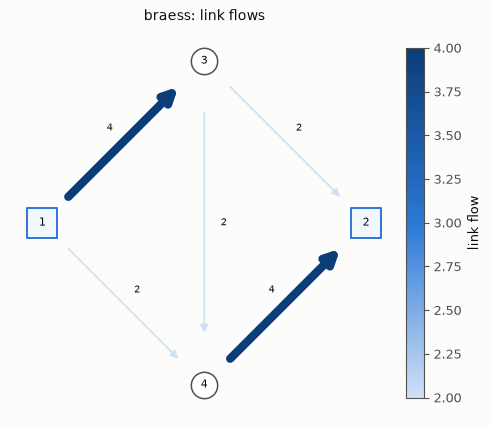
Both figures come from tabench.viz, the house visualizer — every plotted number is one
certified above. Left/top: the certified terminal link flows on the network. Right/bottom:
the emitted flows against the fixed point recomputed in the certify cell — points on the
y = x guide mean the day-to-day process settled on it link-for-link.
# Certified terminal flows on the network (house style via tabench.viz).
display(viz.plot_network_flows(net, final.link_flows))

# Emitted flows vs the Wardrop UE recomputed above (off-diagonal == not settled).
display(viz.plot_flow_scatter(("Wardrop UE", ref_flows), {"dtd-swap": final.link_flows}))

Takeaways & pointers
Certified, not self-reported. The terminal gap and every checkpoint gap came from
Evaluator; the self-reported Beckmann/disequilibrium were diffed and used only to certify the shape of the descent.The day-to-day signature is the point. A UE/SUE solver gives you the fixed point; a day-to-day model gives you the adjustment path to it.
Where next. the SUE sibling
dtd-swap-sue; the link-space projectiondtd-link; the unifying frameworkdtd-unifying; the lineage in the model compendium.