br-ue — Boundedly-rational user equilibrium (Mahmassani & Chang 1987)
What. Boundedly-rational UE relaxes Wardrop’s equality to an indifference band:
a flow is acceptable if every used route is within an absolute threshold ε of its
OD’s cheapest route. The equilibrium is therefore a SET, not a point — br-ue returns
the band-edge flow reached from the free-flow all-or-nothing start
([mahmassani1987on], docs/REFERENCES.md).
Why it is in the benchmark. It is the behavioural relaxation of exact rationality (ADR-008): the scored certificate becomes band-acceptability, not a zero gap. See the model compendium and docs/ARCHITECTURE.md (P1).
Scope. Runs on the built-in BR two-route anchor (demand 10, ε = 1) and certifies band-acceptability. Its Wardrop gap is deliberately non-zero — that is the point.
How this notebook is graded
A notebook never claims a number it does not compute in that cell. Every scored
quantity below is recomputed live by the P1 Evaluator from the flows the model
emitted, in the cell where it is claimed. Model self-reports are shown only as
provenance and diffed against the certificate as an honesty check, exactly as the
harness treats them (README, Certified, not self-reported).
# Setup. `br-ue` is a core model: a plain `pip install -e .` suffices — no
# optional extra, so no guard cell. The inline backend is Agg-based (headless CI
# renders into the notebook); NEVER matplotlib.use("Agg") in-kernel — it silently
# suppresses inline figure capture.
%matplotlib inline
import numpy as np

from tabench import (
    BoundedlyRationalUEModel,
    Budget,
    Evaluator,
    RngBundle,
    Trace,
    br_two_route_scenario,
    viz,
)
The scenario
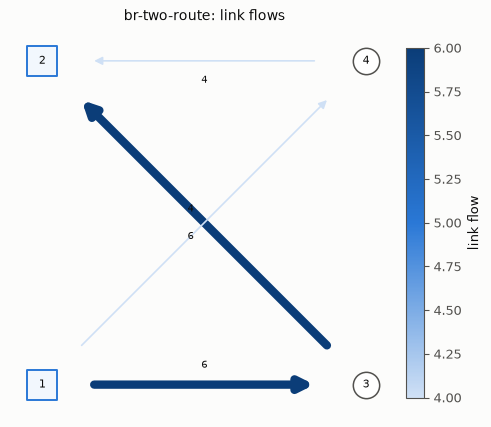
Two disjoint 2-link routes, demand 10, indifference band ε = 1 (native cost units). Both route slopes are 1, so the acceptable set is an interval around the Wardrop split; the free-flow-AON swap stops at the band edge f_A = (D+1)/2 + ε/2 = 6. Content-hashed (P2).
scenario = br_two_route_scenario()
net = scenario.network

print(f"scenario      : {scenario.name}")
print(f"content hash  : {scenario.content_hash()[:16]}…")
print(f"total demand  : {scenario.demand.total}")
print(f"band epsilon  : {scenario.br_epsilon}  (native cost units)")
scenario      : br-tworoute
content hash  : ef0628123c11a4f1…
total demand  : 10.0
band epsilon  : 1.0  (native cost units)
Solve
The model contract (CONTRIBUTING.md): a model receives
(scenario, budget, rng, trace), records checkpoints, and respects the budget.
Budgets are hardware-free (iterations / shortest-path calls; wall-clock is recorded
but never the ranking axis, P7). Whatever the model writes into self_report is
provenance, not a score.
model = BoundedlyRationalUEModel()
bundle = model.solve(scenario, Budget(iterations=100), RngBundle(0), Trace())

final = bundle.final
print(f"model              : {model.name}")
print(f"emitted flows      : {np.round(final.link_flows, 6)}")
print(f"self-reported gap  : {final.self_report['relative_gap']:.3e}  (provenance only)")
print(f"self band excess   : {final.self_report['band_excess']:.4f}  (provenance only)")
model              : br-ue
emitted flows      : [6. 6. 4. 4.]
self-reported gap  : 7.895e-02  (provenance only)
self band excess   : 1.0000  (provenance only)
Certify (P1)
The BR certificate is band-acceptability, not a zero gap: the harness checks that
the average excess cost is within ε (br_acceptable = 1). The ordinary Wardrop gap is
non-zero here — a BR flow is not a Wardrop equilibrium — and that is reported
honestly. We recompute the band-edge anchor (f_A = 6, AEC = 0.6) in-cell.
evaluator = Evaluator(scenario)
metrics = evaluator.evaluate(final.link_flows)
gap = metrics["relative_gap"]
aec = metrics["average_excess_cost"]
print(f"Wardrop relative gap  : {gap:.3e}   (non-zero: a BR flow is not Wardrop)")
print(f"average excess cost   : {aec:.4f}   (band epsilon = {scenario.br_epsilon})")
print(f"band acceptable       : {metrics['br_acceptable']:.0f}")
print(f"feasible              : {metrics['feasible']:.0f}")

assert metrics["feasible"] == 1.0
assert metrics["br_acceptable"] == 1.0
assert aec <= scenario.br_epsilon + 1e-9

# Honesty diff (P1): the (non-zero) Wardrop gap self-report matches the certificate.
assert np.isclose(final.self_report["relative_gap"], gap, rtol=1e-9, atol=1e-9)

# Analytic anchor RECOMPUTED: band edge f_A = (D+1)/2 + eps/2, AEC = (f_A/D)*eps.
demand = scenario.demand.total
eps = scenario.br_epsilon
f_a = 0.5 * (demand + 1.0) + 0.5 * eps
ref_flows = np.array([f_a, f_a, demand - f_a, demand - f_a])
print(f"band edge f_A         : {f_a}  (recomputed)")
assert np.allclose(final.link_flows, ref_flows, atol=1e-4)
assert abs(aec - (f_a / demand) * eps) < 1e-6
Wardrop relative gap  : 7.895e-02   (non-zero: a BR flow is not Wardrop)
average excess cost   : 0.6000   (band epsilon = 1.0)
band acceptable       : 1
feasible              : 1
band edge f_A         : 6.0  (recomputed)
Visualize
Both figures come from tabench.viz. Left/top: the BR band-edge link flows.
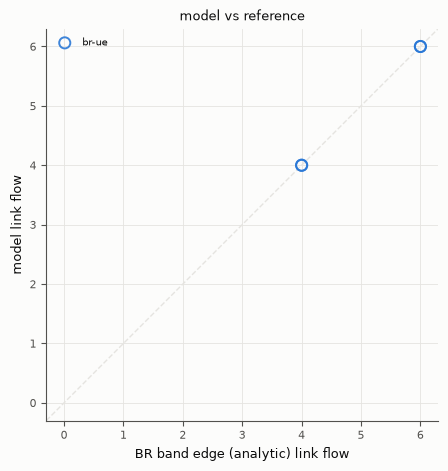
Right/bottom: the emitted flows against the recomputed band edge — on-diagonal means
the swap stopped exactly at the ε-band edge, not the Wardrop point.
display(viz.plot_network_flows(net, final.link_flows))
display(viz.plot_flow_scatter(("BR band edge (analytic)", ref_flows), {"br-ue": final.link_flows}))
Takeaways & pointers
The certificate is the band, not the gap.
br_acceptable = 1with AEC ≤ ε; the non-zero Wardrop gap is reported honestly, not hidden.Set-valued equilibrium. BR-UE is an acceptable set; ε → 0 recovers Wardrop.
Where next. The exact-rationality UE:
bfw; ADR-008 in the model compendium.