TABenchmark
A shared benchmark for 50 years of traffic assignment models. One harness runs everything from Frank–Wolfe (1975) and bush-based equilibrium solvers to external simulators and learned GNN surrogates on identical networks, demand, data availability, and budgets. The harness — never the model — recomputes every scored metric from the link flows a model emits, so a black box cannot self-report its way onto the leaderboard. Full documentation and executed tutorials: https://tabenchmark.readthedocs.io.
Install
pip install -e . # core: numpy + scipy + pyyaml only, Python >= 3.10
Optional extras (the core imports and runs without any of them; models behind a missing extra simply do not register):
Extra |
Adds |
Note |
|---|---|---|
|
learned models |
for CPU-only, install torch from the CPU wheel index first |
|
adapter |
|
|
external engine |
PyPI |
|
house visualizer |
never imported by the core |
|
execute the notebooks ( |
drives |
|
build the readthedocs.io site (Sphinx + MyST) |
needs |
|
pytest + ruff |
|
Quickstart (60 seconds)
python demos/demo_quickstart.py # built-in Braess scenario, no download
Scenario: braess (hash cf00f411cdccec88)
model             certified rel. gap  feasible
----------------------------------------------
aon                        1.912e-01         1
msa                        1.577e-03         1
fw                         7.188e-14         1
cfw                       -2.060e-16         1
bfw                       -2.060e-16         1
toy-surrogate                    nan         0
toy-surrogate’s flows fail the demand-feasibility audit, so its gap is censored to
nan rather than scored — a black box can neither crash the run nor top the leaderboard.
Wrap your own model in three lines — the harness certifies it identically:
from tabench import CallableModel, Budget, load_scenario, run_experiment

model = CallableModel(fn=my_predict, name="my-gnn", trained_on=("tntp-small-v1",))
result = run_experiment(load_scenario("braess"), [model], Budget(iterations=1))
my_predict(scenario, rng) returns link flows; the harness recomputes the relative gap
from them, censors it (nan) if the flows fail the demand-feasibility audit, and refuses
to run at all if trained_on intersects the scenario’s training lineage. CLI equivalent:
tabench run --scenario siouxfalls --models fw,cfw,bfw --iterations 300 --out results/
tabench list      # all scenarios, models, and estimators registered in this install
Repository map
TABenchmark/
├── src/tabench/           # the package (core is numpy/scipy-only)
│   ├── core/              # Scenario (frozen, content-hashed), Capabilities, Budget, Trace, RNG
│   ├── data/              # TNTP parser; checksummed on-demand fetchers (-> ~/.cache/tabench)
│   ├── models/            # road assignment models: AON/MSA/FW/CFW/BFW, bush & path UE, SUE,
│   │   │                  #   SO, elastic, combined, day-to-day, BR/side-constrained/VI,
│   │   │                  #   multiclass, learned surrogates
│   │   └── adapters/      # CallableModel wrapper; external engines (sumo-marouter, dtalite-tap)
│   ├── observe/           # observation processes: FullOD, LinkCounts, StalePriorOD + identifiability
│   ├── estimation/        # T2 OD estimation: entropy, GLS, Spiess, SPSA, Yang'92, DN-Kalman,
│   │                      #   within-day dynamic (Cascetta'93), guarded spsa-sumo
│   ├── metrics/           # the certifiers — every scored metric recomputed here from emitted flows
│   ├── experiments/       # T1 grid + T2 estimation runners, provenance manifests, profiles
│   ├── dnl/               # dynamic network loading: CTM, LTM, Godunov, Tampère node model
│   ├── dta/  tdta/  bottleneck/  # analytical & time-dependent DTA: Merchant–Nemhauser,
│   │                      #   Ziliaskopoulos LP, Vickrey, VI-DUE, Peeta–Mahmassani
│   ├── transit/           # Spiess–Florian optimal strategies
│   ├── newell/            # three-detector traffic-state estimation
│   ├── edoc/              # external-dynamic-engine observational certificate (adr-036/037)
│   ├── viz.py             # plotting helpers ([viz] extra)
│   └── cli.py             # tabench fetch | list | run
├── scenarios/             # declarative YAML scenario cards (ladder 0braess → 4winnipeg, + xu2024;
│                          #   bo4mob is fetch-and-cite, registered separately — not a YAML card)
├── tutorials/             # 58 numbered notebooks, simple → complex: one executed, certified
│                          #   notebook per unit (<NN>-track/<MM>-unit.ipynb; committed with
│                          #   outputs, bar the Java-gated matsim page)
├── demos/                 # demo_quickstart.py, demo_profiles.py
├── tests/                 # 1000+ tests: analytic anchors, published-oracle regressions (pytest -q)
├── tools/                 # doc generators (model compendium, references, evolution graph)
├── docs/                  # architecture, model compendium, validation, roadmap, references, 37 ADRs
└── CITATION.cff, LICENSE  # MIT
Orientation facts (for humans and agents):
Every scored metric is computed in
src/tabench/metrics/, never by a model; model self-reports are provenance only.Scenarios are frozen and content-hashed; benchmark networks are fetched on demand, SHA-256-checksummed, cached under
~/.cache/tabench, and never redistributed.Tests:
pytest -q(numpy core needs no extra). CI runs a py3.10/3.12 core matrix plus dedicatedtorch,sumo,dtalite, anddocs(site build, warnings-as-errors) jobs.Optional-extra models register only when their extra is installed;
import tabenchstays numpy/scipy-only either way.
Models, leaderboard, validation
The full roster — road assignment across five decades, day-to-day dynamics, a transit optimal-strategy model, static and within-day-dynamic OD estimators, and DNL/DTA/state- estimation tracks — ships today, each certified by the same harness and validated against an independent oracle (analytic anchors, published best-known flows, cross-solver agreement).
What each model does and its lineage: docs/MODELS.md · evolution graph
Certified results and per-model oracles: docs/VALIDATION.md
Staged plan toward the full canon: docs/ROADMAP.md
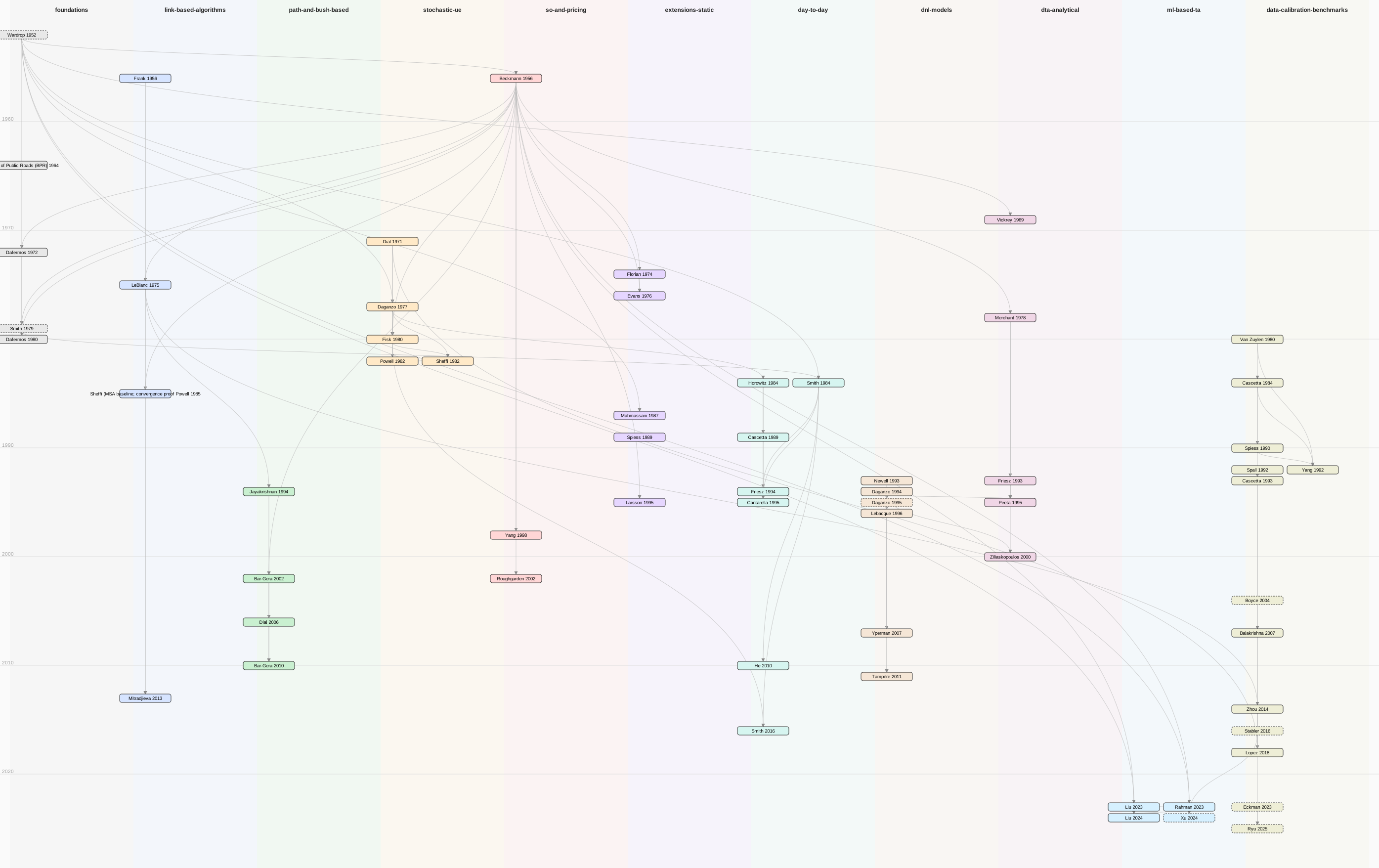
Documentation
The docs site (https://tabenchmark.readthedocs.io) carries the tutorials rendered and executed at build (bar the engine-gated torch/sumo/dtalite pages, which render un-executed), the design principles, the CLI reference, leaderboards, and data licensing. Canonical sources in-repo: docs/ARCHITECTURE.md (design principles P1–P9 and the object model), docs/REFERENCES.md (verified reference canon, BibTeX in docs/references.bib), and 37 architecture decision records in docs/design/ (also in the site sidebar). The one PI-only step to connect the repo to readthedocs.io is docs/RTD_SETUP.md.
Data licensing
Benchmark networks are never redistributed: they are fetched on demand from
commit-pinned URLs, checksum-verified, and cited (tabench fetch <scenario> prints the
citation). Sources: TransportationNetworks
(academic use), Xu et al. 2024 20-US-cities (CC BY 4.0, adr-033), and the lab’s
BO4Mob instances (MIT, adr-034). Package code is MIT.
Citing
Cite the repository via CITATION.cff, plus the original references of any model or dataset you evaluate — all carry verified BibTeX in docs/references.bib.
Contributing
New models, networks, and observation levels are the purpose of this repository — the model contract and conformance checklist are in CONTRIBUTING.md.
Maintained by the UMN Choi Lab · University of Minnesota Twin Cities · MIT License